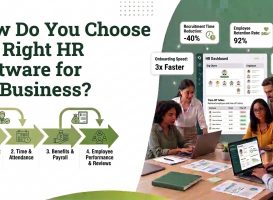
Managing employees becomes more complicated as a business grows. From maintaining employee records to tracking attendance, managing leave requests, processing payroll, and monitoring performance, HR teams often have many responsibilities to handle. Using spreadsheets or separate tools for every task can make these processes slow and difficult to manage.
Choosing the right HR Software can help businesses organize their HR operations, reduce manual work, and improve the employee experience. However, with many options available, selecting the right solution requires careful consideration. The best choice depends on your company size, HR requirements, budget, and future growth plans.
Understand Your Business HR Requirements
Before comparing different software options, identify the HR tasks your business needs to manage. Every organization has different requirements, so a solution that works well for one company may not be suitable for another.
Start by listing your current HR processes. Consider whether you need employee record management, attendance tracking, leave management, payroll support, recruitment tools, performance management, or employee self-service features. If your company is growing quickly, you may also need reporting and analytics capabilities.
Creating a list of essential and optional features makes the selection process easier. It also helps prevent you from paying for features your business does not actually need.
Consider the Size of Your Business
Company size is another important factor when choosing an HR solution. Small businesses usually need simple tools that are affordable and easy to operate. Larger organizations may require advanced functionality, multiple user roles, integrations, and detailed reporting.
For companies with a small workforce, searching for the best HR software for small businesses can be a practical starting point. A smaller organization may benefit more from a straightforward system than from a complex platform designed for large enterprises.
Similarly, HR software for small business should be easy for managers and employees to use without requiring extensive technical training. The goal is to simplify HR processes rather than create additional administrative work.
Check the Most Important Features
Different HR platforms offer different combinations of features. Focus on the functions that directly support your business operations.
Employee Information Management
A centralized employee database allows HR teams to store important information in one place. This can make it easier to manage employee profiles, job details, documents, contact information, and other records.
Attendance and Leave Management
Attendance and leave tracking can become difficult when handled manually. Look for tools that allow employees to submit leave requests and managers to review or approve them digitally.
Payroll Support
If payroll is part of your requirements, check whether the platform supports payroll management or integrates with your existing payroll system. Make sure it can handle the requirements relevant to your business and location.
Performance Management
Performance features can help organizations set goals, conduct reviews, track progress, and provide feedback. These tools can be particularly useful for businesses that want a structured approach to employee development.
Look for Reporting and Analytics
Modern businesses increasingly rely on data when making decisions. HR analytics software can provide useful information about workforce trends, attendance, employee turnover, performance, and other HR metrics.
When evaluating a platform, check whether it provides customizable reports and dashboards. Good reporting tools can help HR managers identify patterns and make more informed workforce decisions.
However, advanced analytics should not be the only consideration. A platform with hundreds of reports may not be useful if the information is difficult to understand or access. Choose a solution that provides the data your team can actually use.
Evaluate Ease of Use
A feature-rich platform is not necessarily the right choice if employees find it difficult to use. Both HR professionals and employees may interact with the system regularly, so the interface should be simple and intuitive.
Ask whether employees can easily access their information, submit requests, update relevant details, and complete assigned tasks. Managers should also be able to review information without navigating through complicated menus.
Before making a purchase, request a product demonstration or trial if one is available. Testing the platform can reveal usability issues that may not be obvious from a product description.
Check Security and Data Protection
HR systems handle sensitive employee information, including personal details, employment records, and sometimes financial information. Security should therefore be a major consideration when comparing different platforms.
Look for providers that use appropriate security measures, access controls, data protection practices, and secure authentication. It is also useful to understand how data is stored, backed up, and recovered in case of technical problems.
Ask the provider about user permissions as well. HR administrators may need access to confidential information that should not be available to every employee.
Consider Integrations and Scalability
Your HR platform should work well with the other systems your business already uses. Depending on your organization, useful integrations may include payroll platforms, accounting software, calendars, communication tools, recruitment systems, or identity management solutions.
Scalability is equally important. Your HR needs may change as your company grows. A platform that works for 20 employees may not provide the functionality required when your workforce reaches 100 or more.
When comparing the best HR software options, consider not only what the system can do today but also whether it can support your future requirements.
Compare Pricing and Overall Value
Price is an important part of the decision, but the cheapest option is not always the most economical. Look at the complete cost, including subscription fees, implementation expenses, additional users, integrations, support, and optional features.
For small companies, transparent pricing can make budgeting easier. Compare the features included in each pricing plan and determine whether the platform provides enough value for your organization.
Think about the time your team could save by automating repetitive HR tasks. A slightly more expensive system may provide better value if it significantly reduces administrative work.
Review Customer Support and Reputation
Reliable customer support can make a major difference when implementing a new HR system. Even an easy-to-use platform may require assistance during setup, migration, or troubleshooting.
Check what support options are available, such as email, live chat, phone assistance, documentation, or training resources. You can also review customer feedback to understand common user experiences.
Instead of relying on a single review, look for recurring patterns across multiple sources. This can give you a more balanced understanding of the platform’s strengths and limitations.
Make a Shortlist Before Making a Decision
After reviewing your requirements, narrow your options to a few suitable platforms. Compare them based on features, usability, security, pricing, integrations, support, and scalability.
If possible, involve HR staff, managers, and employees who will use the system. Their feedback can help identify practical requirements that may otherwise be overlooked.
A short trial with real business scenarios can also be useful. Test common activities such as adding an employee, requesting leave, generating reports, and updating employee information. This gives you a better idea of how the platform will perform in everyday situations.
Conclusion
Choosing the right HR solution starts with understanding your business rather than simply looking for the platform with the longest feature list. Consider your company size, HR processes, required features, security needs, reporting capabilities, integrations, pricing, and future growth.
The best HR software for small companies may be different from the solution required by a large organization. Take time to compare suitable options, test their usability, and evaluate their long-term value before making a final decision. Businesses exploring practical technology solutions can also look at resources from conditions to better understand how digital tools can support modern business operations.
FAQ’s
What should I look for in HR software?
Look for features that match your business needs, such as employee management, attendance, leave tracking, payroll integration, performance management, reporting, security, and employee self-service.
Is HR software useful for small businesses?
Yes. Small businesses can use HR tools to reduce manual administrative work, organize employee information, simplify leave and attendance processes, and create more efficient HR workflows.
How much does HR software cost?
Pricing varies depending on the provider, number of employees, features, and subscription model. Some platforms charge per employee, while others offer fixed monthly or annual plans.
Can HR software integrate with other business tools?
Many modern platforms offer integrations with payroll, accounting, recruitment, communication, and other business applications. Always check the available integrations before choosing a system.
Should a business use cloud-based HR software?
Cloud-based systems can provide convenient access from different devices and locations while reducing the need for businesses to maintain their own HR software infrastructure. However, companies should still evaluate security, privacy, reliability, and provider support before choosing a platform.